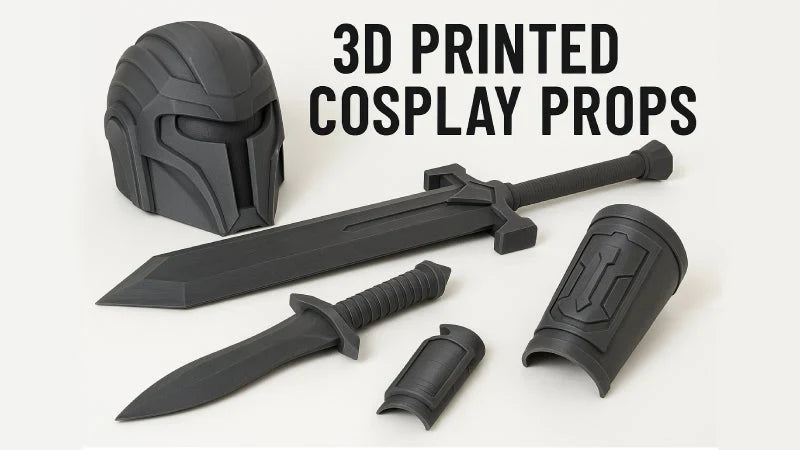
High density foam is the better pick for large weapons, cosplay, and anything you plan to carry or swing. 3D printed PLA is the better pick for small collectibles, figures, desk pieces, and props with fine mechanical detail. Most collections end up using both, and the choice comes down to size and how much handling the piece will take.
Two replicas can look nearly identical in a product photo and behave completely differently once they are in your hands. One weighs about as much as a rolled up poster and bends without breaking. The other holds crisp edges and fine surface detail but will crack if it hits a hard floor. That is the short version of foam vs 3D printed props, and knowing which one you are buying changes what you should expect from it.
Neither material is better in a general sense. They solve different problems. Foam exists because nobody wants to carry a four foot sword made of solid plastic around a convention floor. PLA exists because you cannot carve a working hinge or a two inch collectible out of foam and have it hold up.
This breakdown covers what each material actually is, where each one wins, how they age, and a simple way to decide which belongs in your setup. By the end you should be able to look at any replica listing and know immediately whether the material fits what you want to do with it.
What Are These Two Materials Actually Made Of?
Before comparing them, it helps to know what you are holding. The names get thrown around a lot without much explanation, and the difference in how they are produced explains almost every difference in how they perform.
High Density Foam
High density foam is a closed cell polyethylene, cut and shaped into the prop form, then sealed and painted. It is dense enough to hold an edge and a shape, but light enough that a 40 inch blade weighs less than a laptop. The paint sits on a flexible surface, which is why weathering and metallic finishes on foam look convincing under normal room lighting.
The material flexes rather than snaps. Drop a foam sword and it bounces. That property is the entire reason large weapon replicas are made this way, and it is why something like a Grey Wolf's Sword replica can be a full 40 inches without becoming a hazard to everything in the room.
3D Printed PLA
PLA is a rigid thermoplastic laid down in layers by a printer. It is hard, holds fine geometry, and can produce shapes that would be impossible to cut by hand. Interlocking joints, threaded parts, internal cavities, and tiny surface details all come out cleanly because the printer builds them rather than removing material.
The tradeoff is rigidity. PLA does not flex much before it fails, so a hard impact chips or cracks it. That is rarely an issue for a shelf piece and a real issue for anything you carry. It is also why articulated pieces like a Hollow Knight articulated figure only exist in printed form. Moving joints need a hard material to work.
A high density foam blade weighs a small fraction of the same shape printed in solid PLA. That single number drives most of the foam vs 3D printed props decision.
Which Material Is Safer to Handle?
Foam wins this one without much argument. There is no hard edge, no point that holds up under pressure, and no weight behind a swing. You can hand a foam prop to someone at a party without thinking about it, and you can move around a crowded room while carrying one.
Printed props are safe to own and display, but they behave like any rigid plastic object. Thin sections can snap, and a printed point stays a point. If a piece is going into a room where kids or pets move fast, foam is the more relaxed choice for anything large, and printed pieces are better kept up on a shelf.
Convention rules also lean this way. Most events that allow prop weapons at all restrict them to soft materials, which is a practical reason cosplayers reach for foam almost every time. A hooked or bladed shape like a Butcher's Meat Hook replica is only wearable in a crowd because the material forgives contact.
Detail, Finish, and How Each One Photographs
This is where the comparison gets interesting, because the answer flips depending on scale. At small sizes, printing pulls ahead easily. At large sizes, foam does.
Printed pieces capture micro detail that no hand shaping process can match. Panel lines, rivets, engraved text, and sharp geometric transitions all survive at a few inches tall. A Pokeball collectible reads correctly at desk distance precisely because the seams and button are printed to scale rather than sculpted approximately.
Foam takes paint differently, and at large scale that is an advantage. Big flat surfaces on foam can be layered, dry brushed, and weathered without the visible layer texture that printed surfaces carry unless they are sanded and coated extensively. On camera, a large foam blade reads as metal. A large printed blade often reads as printed plastic under direct light.
Small and intricate goes to printing. Big and dramatic goes to foam. Almost every material argument resolves once you decide which of those two the piece is.
How Each Material Holds Up Over Time
Both materials last a long time in normal indoor conditions. They just fail in different ways when they are treated badly.
Foam's main enemies are pressure and sun. Leave a long foam blade leaning in a corner for six months and it takes a permanent curve. Leave it in direct sunlight and the paint fades and the surface can soften slightly. Neither is a manufacturing flaw, and both are avoidable with a wall mount and a wall that does not catch afternoon light.
PLA's main enemies are heat and impact. It softens at temperatures a hot car interior can easily reach, so printed props should never be left in a vehicle in summer. Impact damage is the other risk, and it is usually a clean break rather than a dent, which at least means it glues back together well. Kept on a shelf indoors, a printed piece holds its shape and color essentially forever.
Size, Weight, and Mounting Considerations
Weight decides how you can display something. Foam props hang from adhesive strips and light hooks, which means you can mount a huge piece on a rental wall without drilling anything. A Helldivers 2 counter sniper replica at over three feet long still hangs on hardware you could hold in one hand.
Printed pieces are heavier per inch and are almost always sized for shelves and desks rather than walls. That is not a limitation so much as a different role. Printed props fill the space around your monitor, on floating shelves, and on your desk, while foam props own the wall behind all of it.
Storage differs too. Foam needs to be laid flat or supported along its length. Printed pieces stack fine in a padded box as long as thin protruding parts are protected.
Side by Side Comparison
| Factor | High Density Foam | 3D Printed PLA |
|---|---|---|
| Best size range | Large, 12 inches and up | Small to mid, under 12 inches |
| Weight | Very light | Moderate for its size |
| Fine detail | Good at scale, limited up close | Excellent, holds tiny features |
| Impact resistance | Flexes and recovers | Can chip or crack |
| Cosplay and carrying | Ideal | Better left on display |
| Wall mounting | Easy, adhesive hooks work | Usually shelf or desk instead |
| Main risk to avoid | Leaning, bending, direct sun | Heat and hard drops |
What About Price?
Printed collectibles usually cost less because they are small and the process is largely automated. Foam props cost more because they are bigger, require hand finishing, and every paint pass is manual work. Comparing prices directly across the two materials is not really useful, since you are comparing a desk piece to a wall piece.
The better question is cost per impact. One large foam replica on a wall changes a room more than five small printed pieces scattered across a desk. If your budget is limited and you want the setup to feel different, put it into one big foam piece first and fill in with printed collectibles later.
How to Decide in Under a Minute
Run through these in order and stop at the first one that matches your situation. The foam vs 3D printed props question usually resolves within the first two.
- Will you carry it, wear it, or take it to an event? Choose foam.
- Is it going on a wall as a focal piece? Choose foam.
- Is it under about a foot tall and meant for a shelf or desk? Choose printed.
- Does it need moving joints or working parts? Choose printed.
- Will people pick it up and look at it closely? Choose printed for detail, foam for durability.
- Still unsure? Buy the one that matches the empty space you actually have.
That last point matters more than people expect. A room with no wall space does not need a four foot sword, and a room with a bare wall and no shelves does not need another small figure.
The Case for Owning Both
The strongest setups mix materials on purpose. Foam handles scale and drama on the wall. Printed pieces handle personality at arm's reach. Together they create depth in a room, with something big to look at from the doorway and something detailed to notice when you sit down.
If you treat foam vs 3D printed props as an either or decision, you end up with a room that is all one note. Treat it as a role assignment instead, and each piece has a clear job. That approach also spreads your spending out, since you can add a printed collectible any month and save the larger foam pieces for when it makes sense.
Frequently Asked Questions
Foam, for almost every situation. It is lighter to carry for hours, safer in a crowd, and far more likely to meet event prop rules. Printed pieces work well for small accessories and armor details that do not take impact.
Not when they are printed at a fine layer height and finished properly. Printed props actually hold more small detail than foam does. Visible layer lines only become an issue on very large flat surfaces, which is exactly where foam takes over.
They rarely break from impact, but they can tear at thin points and take permanent bends if stored badly. Support the full length when storing and keep them off the floor, and a foam prop will stay straight for years.
Dust foam with a dry soft brush and avoid solvents, since they can lift paint and clear coats. Printed pieces handle a slightly damp cloth on unpainted areas, but painted printed props should be treated the same as foam.
Sealed foam takes weathering and metallic finishes beautifully across large areas. Printed plastic holds crisp color separation on small details. Each one is better within its own scale range rather than one being better overall.
Browse high density foam weapon replicas and 3D printed collectibles side by side, and find the piece your space is missing.
Shop All Replicas →
