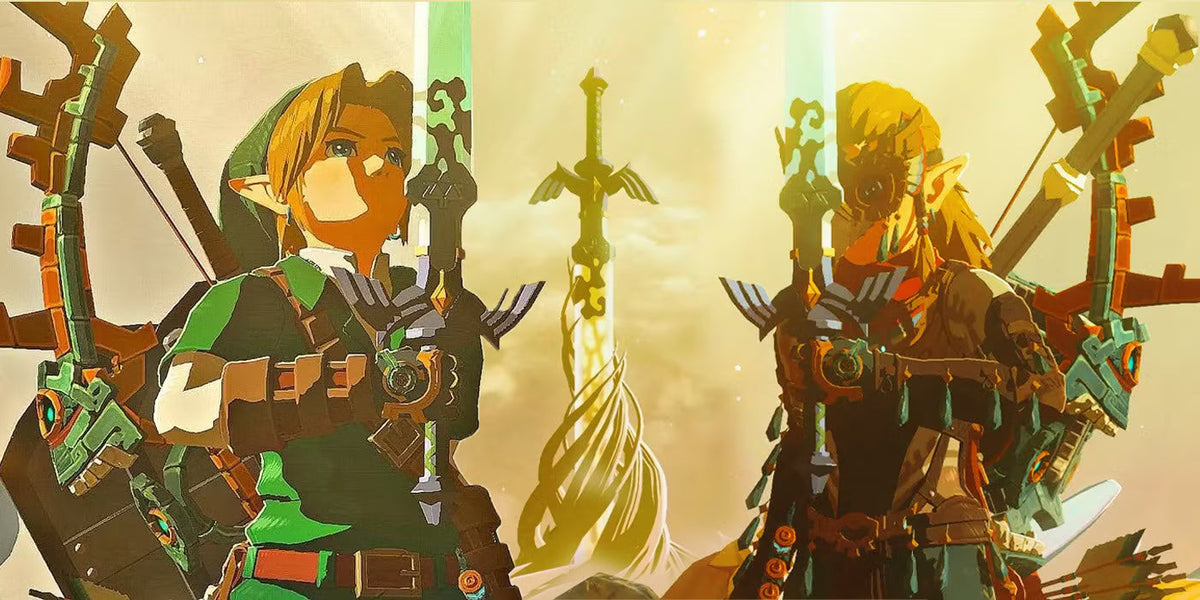
The Master Sword debuted in A Link to the Past with a red grip and yellow guard, then Ocarina of Time locked in the design everyone pictures today: winged crossguard, blue hilt, yellow gem. Every game since has adjusted proportion, color temperature, and wear rather than rethinking the shape. Skyward Sword explained where it came from, and Tears of the Kingdom broke it.
Very few objects in games are as instantly readable as the Master Sword. You can draw it from memory as a shape: two swept wings for a guard, a gem in the center, a long straight blade. That silhouette has survived thirty five years of hardware changes and art direction shifts, and tracking the Master Sword evolution across the series is basically a tour of how Nintendo's visual language changed while one design stayed anchored.
What makes it interesting is how little actually changes. The proportions move, the palette warms or cools, and the surface gains or loses wear, but the core idea never gets touched. That is unusual. Most long running franchises redesign their signature items every few entries.
Here is every major version, what changed, and what each one tells you about the game it appeared in.
What Actually Stays the Same?
Before the game by game breakdown, it helps to name the constants. These are the elements that have survived every version, and they are the reason the sword reads correctly no matter how the rest of the art style shifts.
- A crossguard shaped like two swept wings rather than a straight bar
- A single gem set at the center of the guard
- A straight double edged blade with a visible central ridge
- A wrapped grip in a color that contrasts against the metal
- A Triforce or sacred marking near the base of the blade
The year the Master Sword first appeared, in A Link to the Past. The silhouette established then has stayed essentially intact through every entry since.
A Link to the Past: The Original
The debut version is the one people misremember most. In game it carries a red grip and a yellow crossguard, not the blue and purple palette that later became standard. At 16 bit sprite resolution the design had to survive in a handful of pixels, which forced the winged guard to be exaggerated and unmistakable.
This is also the only era where the sword upgrades into visually different weapons. The Tempered Sword and then the Golden Sword change its color outright, which is a design approach the series abandoned afterward in favor of keeping one canonical look.
Ocarina of Time: The Version Everyone Pictures
This is the one that set the standard. Moving into 3D forced the design to work from every angle, and what came out is the version that has defined the sword ever since: a longsword with a blue hilt, a green wrapped grip, a blue crossguard shaped like extended wings, and a yellow gem at the center.
It is also the version where the sword stops being just a weapon. Placing it back in the Pedestal of Time moves Link between eras, which turns the object into a story mechanism rather than an upgrade. Every later game inherits that weight.
Design wise the lesson here is restraint. The blade itself is completely plain. All the character lives in the guard and the grip, which is exactly why a clean straight profile like a fantasy penetrating sword reads so well as a physical piece. Simple blades let the hilt do the talking.
The Wind Waker: Stylized and Powered Down
The cel shaded version thickens every element. The guard gets chunkier, the proportions shorten, and the whole thing reads more like a toy than a relic, which is entirely deliberate given the art direction.
Narratively this is the most interesting entry. The sword starts dulled, having lost the prayers of two Sages, and only regains its shine after Medli and Makar are awakened. Watching the gem color and the guard change as it recovers is one of the few times the series uses the sword's appearance as a progress bar.
The restored glow is the part that has always been hardest to reproduce physically. A blade that emits light rather than reflecting it needs either translucent material or external lighting, which is why glowing designs like a Halo energy sword replica lean on shape and color saturation to sell the effect instead.
Twilight Princess: The Realistic Take
Twilight Princess gives the sword its most grounded treatment. The palette cools down, the metal picks up real surface detail, and the proportions lengthen into something that would function as an actual weapon. Found in the Sacred Grove among the ruins of the Temple of Time, it also gets the best introduction of any version.
Mechanically it does more here than almost anywhere else. It breaks Link's wolf curse through the sacred light it emits, and once infused with the Sols it cuts through Twilight monsters and clears Dark Fog inside the Twilight Realm.
This version is also the easiest to imagine as a real object, since nothing about it depends on stylization. Large grounded blades like a Grey Wolf's Sword replica occupy roughly the same design space, where the appeal is weight and presence rather than fantasy exaggeration.
Thirty five years of redesigns and the shape never changed. That is the strongest possible argument for getting a silhouette right the first time.
Skyward Sword: The Origin Story
Skyward Sword is the only game that shows you where the sword comes from, and it does it as a visible progression rather than a cutscene. You start with the Goddess Sword, home to the spirit Fi, and it transforms through the three Sacred Flames until Din's Flame produces the Master Sword itself. Zelda's blessing then creates the True Master Sword with the classic look.
Watching a plain blade slowly acquire the winged guard and the gem across a full game is the best explanation the series has ever given for why the design looks the way it does. Every element arrives for a reason.
A Link Between Worlds and Four Swords Anniversary Edition
A Link Between Worlds deliberately mirrors the original, placing the sword in the Lost Woods behind the three Pendants of Virtue. The design goes back to a top down read, but with modern rendering it keeps far more detail than the 16 bit version could. It also brings back upgrades, with Master Sword Lv2 and Lv3 forged from Master Ore by blacksmiths in Hyrule and Lorule.
Four Swords Anniversary Edition earns a mention as the oddity of the group, where the Master Sword is an optional reward from the Realm of Memories and coexists with Link's ability to split into four copies.
Breath of the Wild: Weathered and Alive
Breath of the Wild ages the sword for the first time. The metal is worn, the finish is dulled, and the whole thing looks like it has been sitting in a forest for a century, because it has. That decision does more for the world building than any amount of dialogue.
It is also the first version with real limits. It runs on durability, needs recharging, and requires thirteen Heart Containers before Link can draw it at all. It glows blue near Malice and jumps from 30 to 60 attack power when it does, and the Trial of the Sword upgrades it in stages until the final trials unlock full power and Sword Beams that do not drain durability.
The reactive blue glow is the defining visual, and it is the same trick that makes magic blades work as display pieces. A Moonlight Greatsword replica depends on exactly that combination of cool color and edge highlighting to feel powered rather than painted.
Tears of the Kingdom: Broken and Rebuilt
The boldest thing the series has done with the sword. Gloom corrupts it and it shatters in the opening, leaving you with the Decayed Master Sword at 1 damage and 5 durability. For most of the game the most important object in Hyrule is a stump of useless metal, which is a genuinely striking choice.
Recovering it involves the Light Dragon and a long stretch of time, and the restored version is the strongest it has ever been in gameplay terms. It gains power near Gloom enemies, gains more against Phantom Ganon and Ganondorf, and becomes unbreakable in those fights. It can also be fused with materials like any other weapon, which is the first time the series has let you visually modify it.
Design Changes at a Glance
| Game | Design Note | What Was New |
|---|---|---|
| A Link to the Past | Red grip, yellow crossguard | Tempered and Golden Sword upgrades |
| Ocarina of Time | Blue hilt, winged guard, yellow gem | The definitive 3D silhouette |
| The Wind Waker | Thicker, shorter, cel shaded | Dulled state that visibly restores |
| Twilight Princess | Cooler palette, realistic metal | Breaks the wolf curse, Sol infusion |
| Skyward Sword | Built up from the Goddess Sword | The full origin, and Fi |
| A Link Between Worlds | Modern top down detail | Lv2 and Lv3 via Master Ore |
| Breath of the Wild | Weathered and aged | Durability, recharge, reactive blue glow |
| Tears of the Kingdom | Shattered, then restored | Decayed state and material fusing |
Why This Design Has Lasted So Long
The Master Sword evolution is really a story about one very good decision made early. The winged guard gives the shape a distinct outline at any resolution, from a handful of pixels to a modern render. Nothing else on the sword competes with it, which means the design can be simplified endlessly without losing identity.
Color does the rest. Blue and gold against a plain blade is a combination that stays readable in bright daylight and in a dark dungeon, which matters more than it sounds when a weapon needs to be visible in every environment a game contains.
That is also the rule to apply to anything you put on a wall. A distinct outline plus a limited palette will outperform a busier design every time, whether it is a full sized blade or a small printed piece like a Scythe of Quakes prop sitting on a shelf.
Frequently Asked Questions
A Link to the Past, released in 1991. That version had a red grip and yellow crossguard rather than the blue palette most people associate with the sword today.
Skyward Sword tells the origin. It begins as the Goddess Sword, inhabited by the spirit Fi, and is transformed through the three Sacred Flames before Zelda's blessing produces the True Master Sword.
It reacts to Malice. When it glows, its attack power doubles from 30 to 60. Tears of the Kingdom uses a similar system, with bonuses near Gloom enemies and larger bonuses against Phantom Ganon and Ganondorf.
In several games. A Link to the Past has the Tempered and Golden Sword, A Link Between Worlds has Lv2 and Lv3 forged with Master Ore, and Breath of the Wild raises its power through the Trial of the Sword.
Gloom corrupts and shatters it early on, leaving the Decayed Master Sword with almost no power. It is restored later through the Light Dragon, and the recovered version is the most powerful the sword has ever been.
Browse high density foam sword replicas built at display scale, light enough to mount on any wall and detailed enough to hold up close.
Shop Sword Replicas →
